
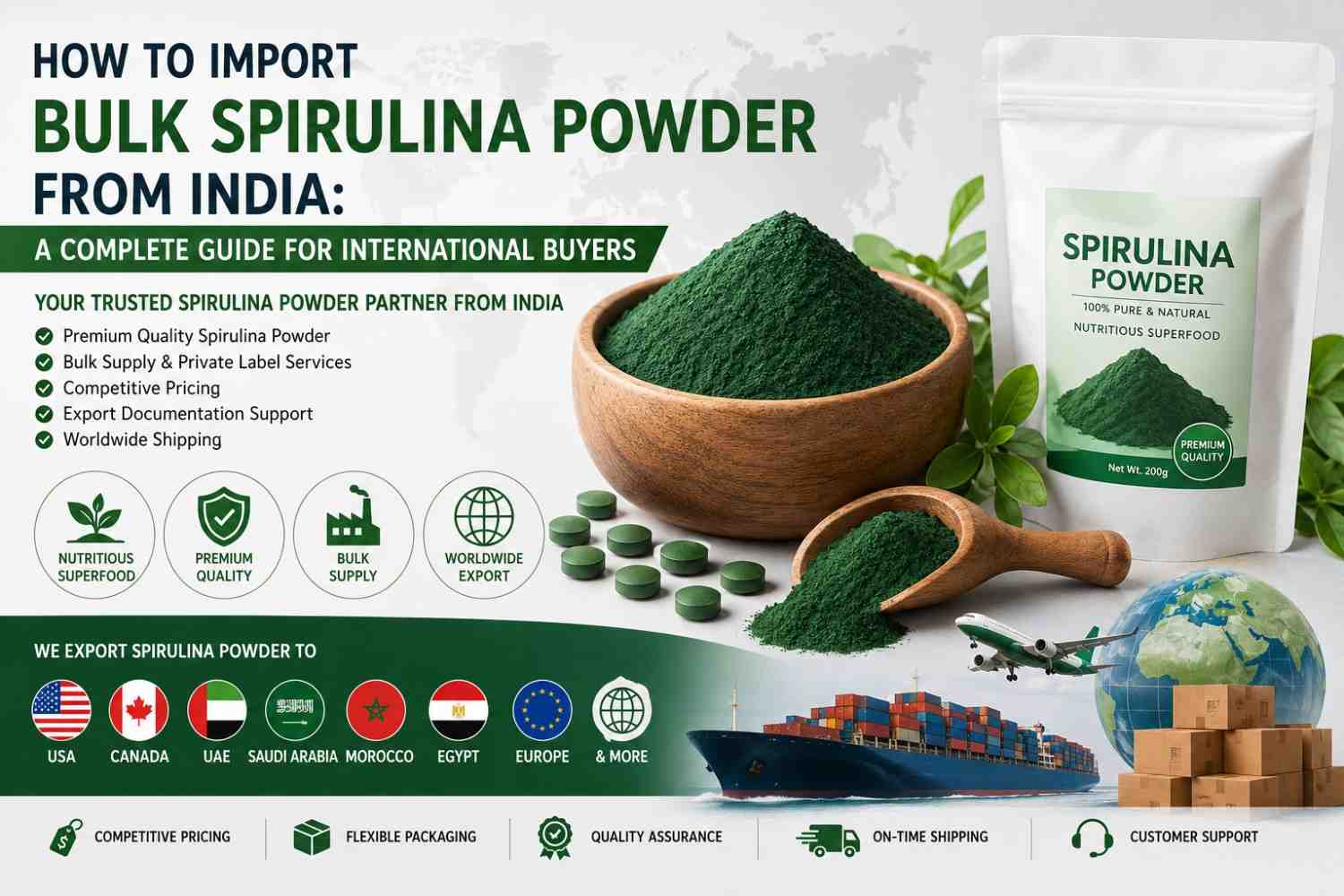
How to Import Bulk Spirulina Powder from India: A Complete Guide for International Buyers
Global demand for nutraceutical and functional food ingredients has been on a steady upward trajectory for several years, and Spirulina Powder sits squarely at the center of that trend. As nutraceutical brands, supplement manufacturers, and functional beverage companies expand their plant-based and protein-forward product lines, the search for a dependable bulk Spirulina Powder supplier has become a priority for importers and distributors across the Middle East, North Africa, Europe, North America, and Asia Pacific.
This shift is being driven by several converging factors: rising consumer interest in plant-based nutrition, the continued growth of the global nutraceutical market, and the popularity of functional foods and beverages that incorporate natural, nutrient-dense ingredients. Spirulina Powder, valued for its naturally high protein content and recognizable green pigmentation, fits squarely into all three trends — which is why it continues to appear in supplement capsules, protein blends, wellness drinks, and private label retail products worldwide.
India has emerged as one of the more significant sourcing destinations for this ingredient, and for good reason. A combination of established processing infrastructure, competitive production economics, and growing export experience has positioned Indian manufacturers — including HennaHub India — as practical partners for international buyers looking to import Spirulina Powder from India at bulk volumes. This guide is built for exactly that audience: importers, distributors, nutraceutical brands, supplement manufacturers, food and beverage companies, and private label buyers who need a clear, practical roadmap for sourcing Spirulina Powder internationally — without the guesswork.
What is Spirulina Powder?
Spirulina Powder is produced from blue-green microalgae, commercially associated with Spirulina (Arthrospira spp.). After cultivation, the algae is harvested, dried, and milled into a fine powder — typically dark green to blue-green in color — that can be incorporated into a wide range of finished products.
In commercial applications, Spirulina Powder is most commonly used in:
- Nutraceutical formulations — capsules, tablets, and powder-based supplement blends
- Functional foods — health food products and nutrition bars or mixes
- Functional beverages — smoothies, wellness drinks, and green superfood blends
- Sports nutrition — protein blends and recovery-focused formulations
- Private label retail products — branded supplement pouches and jars for consumer markets
The ingredient is recognized in the nutraceutical industry for its naturally high protein content and its naturally occurring pigments, including phycocyanin, which contributes to its distinctive blue-green hue. This combination of nutritional density and natural pigmentation has made Spirulina Powder a long-standing fixture in the global wellness and supplement industry, with consistent interest from manufacturers across food, beverage, and supplement categories.
Why Import Spirulina Powder from India?
For international buyers comparing sourcing destinations, India offers a combination of manufacturing scale, pricing competitiveness, and export infrastructure that has made it an increasingly common choice for bulk Spirulina Powder procurement. Here's what typically draws buyers to Indian suppliers.
Manufacturing Capabilities
Established Indian manufacturers, including those based in ingredient-processing hubs like Rajasthan, have built dedicated processing infrastructure for herbal powders and nutraceutical ingredients. This includes drying, milling, sieving, and packaging capacity suited to both retail-scale and bulk export orders. A genuine Spirulina Powder Manufacturer India will be able to walk you through their processing flow and quality control checkpoints rather than simply quoting a price.
Competitive Pricing
India's combined advantages in raw material access, labor, and production scale generally translate into more competitive landed costs for international buyers compared to sourcing from several other regions — without necessarily compromising on the ability to meet export specifications, provided the supplier maintains proper quality control.
Export Experience
A capable Spirulina Powder Exporter India will have direct experience navigating the documentation, packaging, and logistics requirements of international shipping — not just domestic sales. This matters enormously when your shipment needs to clear customs smoothly in markets like the UAE, the EU, or the United States.
Bulk Production Capacity
Buyers ordering recurring volumes — whether 5kg trial batches or container-load shipments — need a supplier who can scale production predictably. Indian manufacturers serving the export market are generally structured to handle both retail-pack and bulk-format orders within the same production cycle.
Private Label Opportunities
Many Indian Spirulina Powder manufacturers, including HennaHub India, offer private label and OEM services, allowing distributors and supplement brands to launch their own branded product without investing in their own manufacturing infrastructure.
Documentation Support
Reliable exporters provide the full documentation package international buyers need — Certificate of Analysis, MSDS, Certificate of Origin, commercial invoice, and packing list — as a standard part of the order process rather than an added negotiation.
Industries That Import Bulk Spirulina Powder
Demand for bulk Spirulina Powder spans a fairly wide set of B2B buyers, each with slightly different priorities when it comes to specification, packaging, and documentation.
Nutraceutical manufacturers typically require consistent mesh size and moisture content for capsule and tablet production, along with a reliable COA for every batch. Dietary supplement brands often prioritize private label packaging and label development support alongside product quality. Food manufacturers incorporating Spirulina Powder into health foods and nutrition products tend to focus on color consistency and food-grade documentation. Beverage companies formulating smoothies and functional drinks generally look for fine, easily dispersible powder with consistent solubility characteristics. Health and wellness brands frequently combine product quality requirements with branding and packaging design needs. Private label companies and distributors, meanwhile, are usually evaluating suppliers on flexibility — MOQ, packaging customization, and turnaround time — as much as on the ingredient itself.
How to Choose the Right Bulk Spirulina Powder Supplier
Selecting a Spirulina Powder Wholesale Supplier is not simply a matter of comparing quotes. International buyers should evaluate prospective suppliers against a structured checklist before committing to a bulk order.
- Manufacturing capability — Does the supplier process the product themselves, or are they trading/repacking from a third party? Direct manufacturers generally offer better quality consistency and pricing transparency.
- Certifications and quality systems — Ask what quality control processes are in place, from raw material evaluation through to final packaging inspection.
- Documentation availability — Confirm upfront whether COA, MSDS, Certificate of Origin, and other export documents are provided as standard, and how quickly they can be issued.
- Packaging options — Check whether the supplier can accommodate your required pack sizes, from retail pouches to bulk export packaging, and whether private label packaging is available.
- Export experience — Ask about prior shipments to your region specifically. A supplier experienced in shipping to the UAE or Europe will understand region-specific documentation nuances that a domestic-only seller may not.
- Communication standards — Responsiveness during the inquiry stage is often a reliable indicator of how the relationship will function after the order is placed. Look for clear, prompt communication via email or WhatsApp.
Spirulina Powder Specifications Buyers Should Check
Before finalizing an order, buyers should review the following specification points with their supplier:
| Specification | What to Check |
|---|---|
| Appearance | Fine, uniform powder, free from visible contamination or clumping |
| Color | Dark green to blue-green; significant variation between batches can signal inconsistent processing |
| Mesh size | Commonly 80–100 mesh; finer/coarser grades available on request |
| Packaging | Matched to use — retail-ready pouches or bulk export bags/drums |
| Shelf life | Typically ~24 months when stored correctly (cool, dry place) |
| Documentation | Specification sheet and COA with every batch; MSDS on request |
Packaging Options for Bulk Spirulina Powder
Packaging flexibility is one of the more practical differentiators between Spirulina Powder suppliers, since buyer requirements vary significantly by end use.
Retail packaging is generally available in 100g, 250g, 500g, and 1kg formats, suited to consumer-facing products or smaller B2B trial orders. Private label packaging allows distributors and supplement brands to apply their own branding, label design, and pack format to retail-ready products without managing manufacturing themselves. Wholesale packaging in 5kg and 10kg formats suits distributors and smaller-volume B2B buyers who need manageable bulk quantities without committing to full container loads. Export packaging, typically in 25kg formats using food-grade bags, HDPE drums, or corrugated boxes, is designed for larger international shipments and built to withstand extended transit and customs handling.
A supplier that can move fluidly between these formats — rather than offering only one or two pack sizes — gives buyers more flexibility as their order volumes grow.
Export Documentation Required
Proper documentation is one of the most common points of friction in international ingredient trade, and it's worth understanding what should be included with every Spirulina Powder shipment. Standard Spirulina Powder Export Documentation typically includes:
- Commercial Invoice — transaction value, buyer/seller information, and product description for customs purposes
- Packing List — itemizes the shipment's contents, weights, and packaging configuration
- Certificate of Origin — confirms country of manufacture, often required for tariff treatment or customs clearance
- Certificate of Analysis (COA) — verifies the specific batch meets agreed specifications
- MSDS (Material Safety Data Sheet) — supports import compliance and internal safety documentation
- Product Specification Sheet — outlines agreed technical parameters
- Shipping documents — bill of lading (sea freight) or airway bill (air freight)
Buyers should request confirmation of which documents will be provided before finalizing an order, rather than assuming they'll be included automatically — documentation practices vary considerably between suppliers.
Shipping Methods for International Buyers
Bulk Spirulina Powder shipments are typically moved via either air freight or sea freight, with the right choice depending on order volume, budget, and delivery timeline. Air freight is generally used for smaller, time-sensitive shipments — sample orders, trial quantities, or urgent restocks — where speed outweighs the higher per-kilogram cost. Sea freight is the more cost-effective option for larger volumes and is typically arranged as either FCL (Full Container Load) for buyers ordering full container quantities, or LCL (Less than Container Load) for buyers who need a smaller volume shipped without paying for an entire container.
Regional considerations vary by destination:
- UAE and Saudi Arabia — Well-served by both air and sea freight routes from Indian ports, with relatively well-established customs processes for food and nutraceutical ingredients.
- Morocco, Egypt, and Libya — Sea freight is commonly used for bulk orders; buyers should confirm port-specific documentation requirements in advance, as these can vary by country.
- Europe — Sea freight (FCL or LCL depending on volume) is standard for bulk orders, with transit times generally longer than Middle East routes.
- USA — Both air and sea freight are used depending on order urgency and volume; FDA-related import considerations should be discussed with your customs broker, as ingredient import requirements can vary by intended end use.
Buyers new to importing should discuss Incoterms (FOB, CIF, etc.) directly with their supplier to clarify exactly where responsibility for freight, insurance, and customs clearance shifts between buyer and seller.
Private Label Spirulina Powder Opportunities
For distributors and supplement brands looking to expand their product range without building their own manufacturing capability, Private Label Spirulina Powder programs offer a practical path to market.
A typical private label arrangement covers several components: OEM manufacturing, where the supplier produces the product to the buyer's specification under the buyer's brand name; branding and packaging design, including pouch or jar design tailored to the buyer's target market; label development, ensuring compliance with destination-market labeling requirements; and distributor programs, which may include tiered pricing or exclusivity arrangements for buyers committing to recurring volumes.
This model is particularly relevant for supplement brands and health food companies that have strong distribution or retail relationships but lack in-house production infrastructure. Working with a manufacturer that already has export experience also reduces the operational burden of managing documentation and logistics independently.
Common Challenges When Importing Spirulina Powder
Quality variation between batches is one of the most common issues, often caused by inconsistent raw material sourcing or inadequate in-process quality control on the supplier's end. The solution is straightforward in principle, if not always easy to enforce: insist on a batch-specific COA for every shipment, and consider periodic third-party testing for high-volume recurring orders.
Documentation issues — missing, incomplete, or incorrect export paperwork — can delay shipments at customs and create unplanned costs. Buyers should confirm the full documentation package in writing before the order is finalized, not after the shipment has left the supplier's facility.
Packaging concerns, such as inadequate moisture protection or packaging unsuited to extended sea freight transit, can compromise product quality before it even reaches the buyer. Discussing packaging specifications upfront — particularly for export-format orders — helps avoid this.
Supplier reliability, including inconsistent communication or missed delivery timelines, is often the hardest issue to detect before placing a first order. Requesting references, reviewing export history, and starting with a smaller trial order before committing to large recurring volumes are practical ways to manage this risk.
Why Hennahub India is a Reliable Spirulina Powder Supplier
HennaHub India is a manufacturer and exporter of herbal powders and nutraceutical ingredients, including Spirulina Powder, based in Sojat, Rajasthan. Rather than positioning itself as the largest or only option in the market, HennaHub India focuses on a set of practical capabilities that matter to B2B buyers: export-oriented operations built around international shipping and documentation requirements, bulk supply capacity across retail, wholesale, and export packaging formats, flexible packaging solutions including private label options for distributors and supplement brands, responsive customer support through direct email and WhatsApp communication, and documentation assistance covering COA, MSDS, Certificate of Origin, and standard export paperwork.
These are deliberately framed as genuine operational capabilities rather than exaggerated claims — buyers evaluating any supplier, including HennaHub India, should verify these points directly through samples, documentation requests, and direct conversation with the export team before placing a bulk order.
Frequently Asked Questions
How do I import Spirulina Powder from India?
Start by identifying a manufacturer or exporter with export experience, request samples and documentation (COA, specification sheet), agree on packaging and Incoterms, and confirm export documentation before shipment. Most suppliers, including HennaHub India, will guide you through this process directly.
What is the MOQ for bulk Spirulina Powder?
MOQ varies by supplier and depends on packaging format and destination. It's best to share your required quantity directly with the supplier so they can confirm MOQ for your specific order.
Can I order samples before placing a bulk order?
Yes, most established suppliers can arrange samples for serious buyers evaluating the product for their formulation or resale.
Do you provide a Certificate of Analysis (COA)?
Yes — a COA confirming batch-specific specifications should be provided with every shipment by a reliable supplier.
Do you provide an MSDS (Material Safety Data Sheet)?
Yes, MSDS documentation is typically available on request to support import compliance and safety record-keeping.
Do you offer private label manufacturing?
Many Indian Spirulina Powder manufacturers, including HennaHub India, offer private label and OEM services covering packaging, branding, and label design.
Which countries do exporters typically supply to?
Common export destinations for Indian Spirulina Powder suppliers include the UAE, Saudi Arabia, Morocco, Egypt, Libya, several European countries, the USA, Canada, and parts of Asia Pacific such as Australia, Malaysia, and Singapore.
What packaging sizes are available?
Retail packaging typically ranges from 100g to 1kg, wholesale packaging from 5kg to 10kg, and export packaging commonly at 25kg using food-grade bags, HDPE drums, or corrugated boxes.
How long does shipping take?
Transit time depends on the shipping method and destination — air freight is faster but costlier, while sea freight (FCL or LCL) is more economical for larger volumes but takes longer. Your supplier should provide an estimated timeline with your quote.
Can you supply distributors on a recurring basis?
Yes, most export-focused manufacturers structure their operations to support both one-time bulk orders and recurring distributor supply arrangements.
What documents are required for importing Spirulina Powder?
Typically a Commercial Invoice, Packing List, Certificate of Origin, COA, MSDS, and shipping documents (bill of lading or airway bill). Some destination countries may require additional documentation — check with your customs broker.
Is Spirulina Powder from India export-quality?
Export quality depends on the specific manufacturer's processing and quality control standards, not the country of origin alone. Always verify specifications and request a COA rather than assuming quality based on origin.
Can I request a custom specification (mesh size, packaging, etc.)?
Yes, most manufacturers can accommodate customized mesh size and packaging requirements, though this should be discussed and confirmed before order finalization.
What Incoterms are typically used for Spirulina Powder exports?
FOB and CIF are common, though the right choice depends on your logistics setup and freight-forwarding relationships. Discuss this directly with your supplier.
How do I verify a supplier's export experience?
Ask for references or details of past shipments to your region, and request transparency around documentation processes. A supplier with genuine export experience will discuss this readily.
Can small distributors order smaller trial quantities?
Yes, many suppliers accommodate smaller trial orders before scaling to larger recurring volumes, though this varies by MOQ policy.
What is the shelf life of bulk Spirulina Powder?
Typically around 24 months when stored in a cool, dry environment, though this should be confirmed with your specific supplier and batch.
Do suppliers provide product specification sheets?
Yes, a detailed specification sheet outlining appearance, mesh size, moisture, and other parameters should be available before you place an order.
Can Spirulina Powder be used for both food and supplement applications?
Yes, depending on the grade and specification, Spirulina Powder is used across nutraceutical, food, and beverage applications — confirm the intended use with your supplier to ensure the right grade is supplied.
How do I get a quote for bulk Spirulina Powder from India?
Contact the supplier directly with your required quantity, destination country, and intended application. Most exporters, including HennaHub India, respond to quote requests within 24 hours via email or WhatsApp.
Conclusion
Importing bulk Spirulina Powder from India offers genuine advantages for nutraceutical brands, supplement manufacturers, food and beverage companies, and distributors — provided the sourcing process is approached methodically. India's combination of established processing infrastructure, competitive pricing, and growing export experience makes it a practical sourcing destination, but the quality of any individual shipment still depends entirely on the specific supplier you choose.
Buyers who take the time to verify manufacturing capability, request proper documentation (COA, MSDS, Certificate of Origin), confirm packaging suited to their use case, and clarify shipping terms upfront are far less likely to encounter the quality, documentation, or reliability issues that commonly affect first-time importers. For distributors and supplement brands, private label and OEM partnerships offer an additional path to building a Spirulina Powder product line without managing manufacturing directly.
A reliable bulk Spirulina Powder supplier should function as a long-term partner, not a one-time transaction — supporting your documentation needs, accommodating your packaging requirements, and communicating clearly as your order volumes grow.
Request Bulk Spirulina Powder Quote from Hennahub India
Email: sales@hennahub.in | WhatsApp: +91 89555 56789